



- Home
- News
- Ecosphere
- Аnimals & plants
- The planet’s ancient inhabitants, who appeared before the dinosaurs and trees
The planet’s ancient inhabitants, who appeared before the dinosaurs and trees
World Jellyfish Day is celebrated on 3 November.

 World Jellyfish Day on 3 November: facts about the ancient inhabitants of the seas


3 November marks an unofficial but extremely interesting environmental celebration — World Jellyfish Day. The aim of this day is to draw public attention to some of the oldest and most marvellous creatures on our planet, to dispel myths about them and to explain their importance for the balance of the world’s oceans.
The celebration was initiated by a group of oceanographers and marine biologists who decided to dedicate a day in November to animals that have existed on Earth for over 500 million years — they have outlived the dinosaurs, mass extinctions and the emergence of the first trees.
Unique anatomy: living wonders of nature
Jellyfish belong to the phylum Cnidaria (cnidarians) and lack many of the organs considered essential for most animals:
- No brain, heart or bones: a jellyfish’s body is 95–98 per cent water. They have no central nervous system or circulatory system — instead, they have a simple, diffuse nervous network.
- Natural bioluminescence: many species have the ability to glow in the dark thanks to special proteins (in particular, the green fluorescent protein, GFP), the discovery of which revolutionised molecular biology and medicine in its day.
- Biological immortality: the species Turritopsis dohrnii is capable of reverting from the adult jellyfish stage back to the polyp stage in the event of stress or injury, making it potentially ‘immortal’.
Jellyfish in the Black Sea and the Sea of Azov
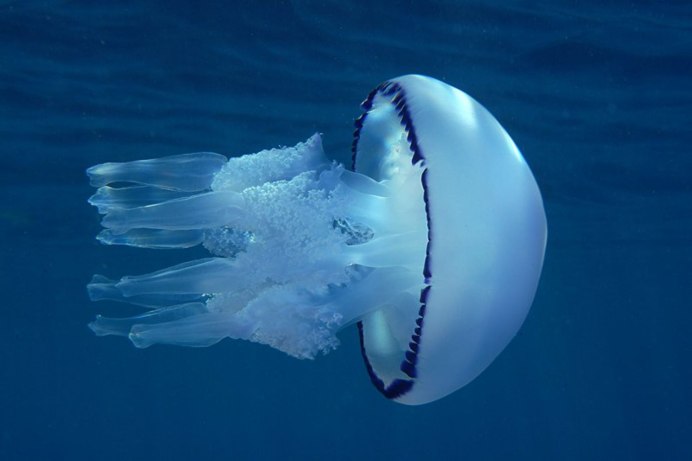
In the Black Sea, the two most common species of jellyfish are: Aurelia (Aurelia aurita) — which is transparent and harmless to humans — and Barrel jellyfish (Rhizostoma pulmo) — a larger jellyfish with purple or blue edging, whose stinging cells can cause an unpleasant burning sensation on the skin, similar to a nettle sting.
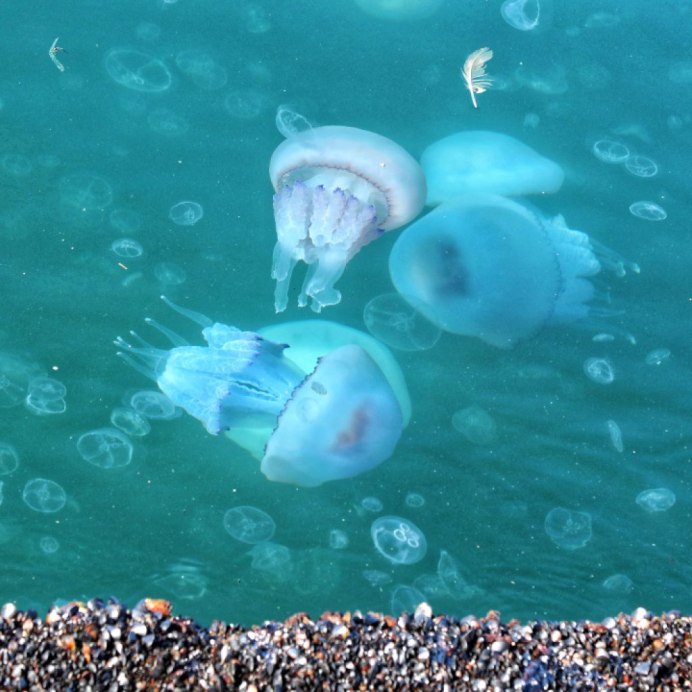
In recent years, a phenomenon known as a ‘population explosion’ of jellyfish has been observed in the Black Sea and, in particular, in the Sea of Azov. Scientists cite the following as the main causes:
- Increases in water salinity and temperature: due to climate change and a reduction in freshwater river flow, conditions are becoming ideal for the reproduction of Cornoroths.
- Overfishing: jellyfish and small fish (sprat, anchovy) compete for the same food source — zooplankton. A decline in fish populations paves the way for a mass proliferation of jellyfish.
- Environmental pollution and military operations: the release of organic substances and the destruction of ecosystems create a favourable environment for jellyfish polyps.
Importance to the ecosystem
Although holidaymakers often see jellyfish as a nuisance when swimming, they play a crucial role in the marine food chain. They serve as food for many species of fish, sea turtles (particularly leatherback turtles) and some birds. Furthermore, the jellyfish’s bell provides reliable shelter for the fry of small fish from predators.
World Jellyfish Day is an opportunity to view these transparent travellers of the seas not with fear, but with admiration and respect for their history stretching back millions of years.
Photo source: poknok.art
Read more news on GreenPost.


