



- Home
- News
- Agrosphere
- The collapse of the Crimean bridge blocked shipping between the Black and Azov seas
The collapse of the Crimean bridge blocked shipping between the Black and Azov seas
The automobile part of the Crimean Bridge collapsed into the Kerch Strait.

 Image: screenshot from video / Glavcom


On the night of November 17, the Defense Forces of Ukraine and the Security Service of Ukraine (SBU) struck the Crimean (Kerch) Bridge, causing the collapse of a metal arch and a road span under it. The General Staff of the Armed Forces of Ukraine stated that the road section of the crossing is “dead” and no car will pass through it, while the railway branch is still standing, but with a damaged arch. This is the second attack on the bridge in a day: after the attack on November 16, satellite images had already recorded damage to the roadbed and deformation of one of the arches.
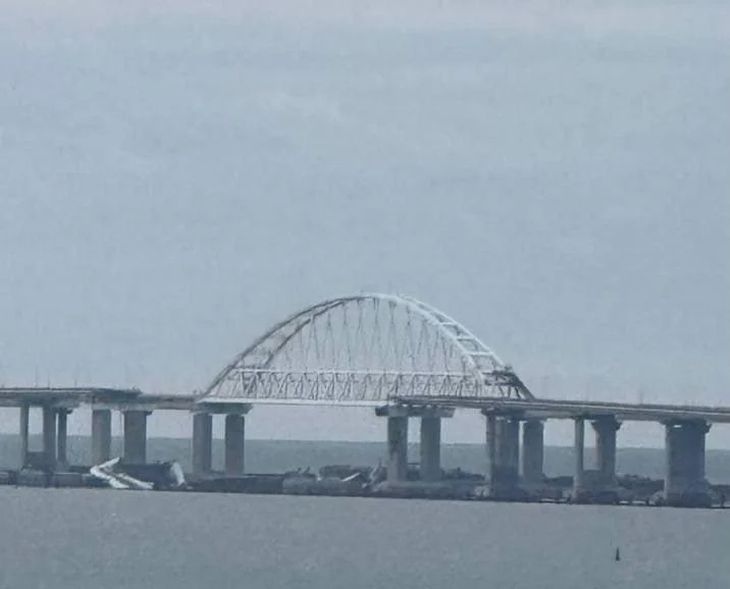
According to the SBU, the operation was prepared for about a month and consisted of seven stages: for several weeks, the Ukrainian military destroyed air defense systems, radars, and electronic warfare equipment on the approaches to the bridge. The decisive blow to the automobile part was delivered by Alpha special forces with Palanytsia drone missiles, and the railway part, according to Volodymyr Zelensky, was struck by Neptune missiles, a Ruta drone missile, and an FP-5 Flamingo cruise missile. The Russian Ministry of Transport initially announced that there were no casualties, but later the occupying leader of Crimea, Sergei Aksyonov, as reported by Reuters, reported two deaths.
Road traffic on the bridge has been stopped. According to Reuters, rail traffic has been restored after a short break, although the Ukrainian Defense Ministry says the railway section is critically damaged. The main flow between occupied Crimea and Krasnodar Krai is now maintained by the Kerch ferry, which depends on the weather and can be stopped for a long time in winter. Another way is a land corridor through occupied Mariupol and Volnovakha, which is in the zone of defeat of Ukrainian forces. The occupation "governor" of Sevastopol, Mikhail Razvozhaev, called for postponing trips to Russia, while assuring that the city's supplies will not be affected. Kremlin spokesman Dmitry Peskov promised that the bridge would be restored and that it would become "even better."
The consequences for shipping are no less tangible . The depth of the Kerch Strait is only 3–6 meters, so all large-tonnage vessels between the Black and Azov Seas pass through the Kerch-Yenikalsky Canal, about 120 meters wide, which runs right under the central arch of the bridge. The debris fell directly into the fairway, and, according to the Crimean Wind monitoring channel, large merchant and military vessels are physically unable to bypass the blockage. According to one of the analytical reports, about 6 thousand tons of steel ended up at the bottom of the canal. This effectively cuts off the ports of the Sea of Azov from the exit to the Black Sea.
For Russian grain exports, the blow came at an extremely sensitive time. Submission of applications for passage through the Kerch Strait was suspended on July 10 after attacks on Russian ships, and only at the end of October did the Russian authorities issue the first permits for grain carriers, some of which were to be escorted by the Navy. Along with other cargoes, the export of grain stolen in the occupied territories was resumed from Azov ports. In September, seaborne exports of Russian grain fell by 61.9% year-on-year to almost 2 million tons, while shipments from ports in the Azov-Black Sea basin decreased by 93.7% to about 300 thousand tons. The bOval may significantly delay the resumption of Azov shipping, as the canal will have to be cleared of debris. This requires special equipment and complex underwater work, so exporters, who are already partially reorienting to Baltic ports, will have to put up with higher logistics costs.
Read more news on GreenPost.


